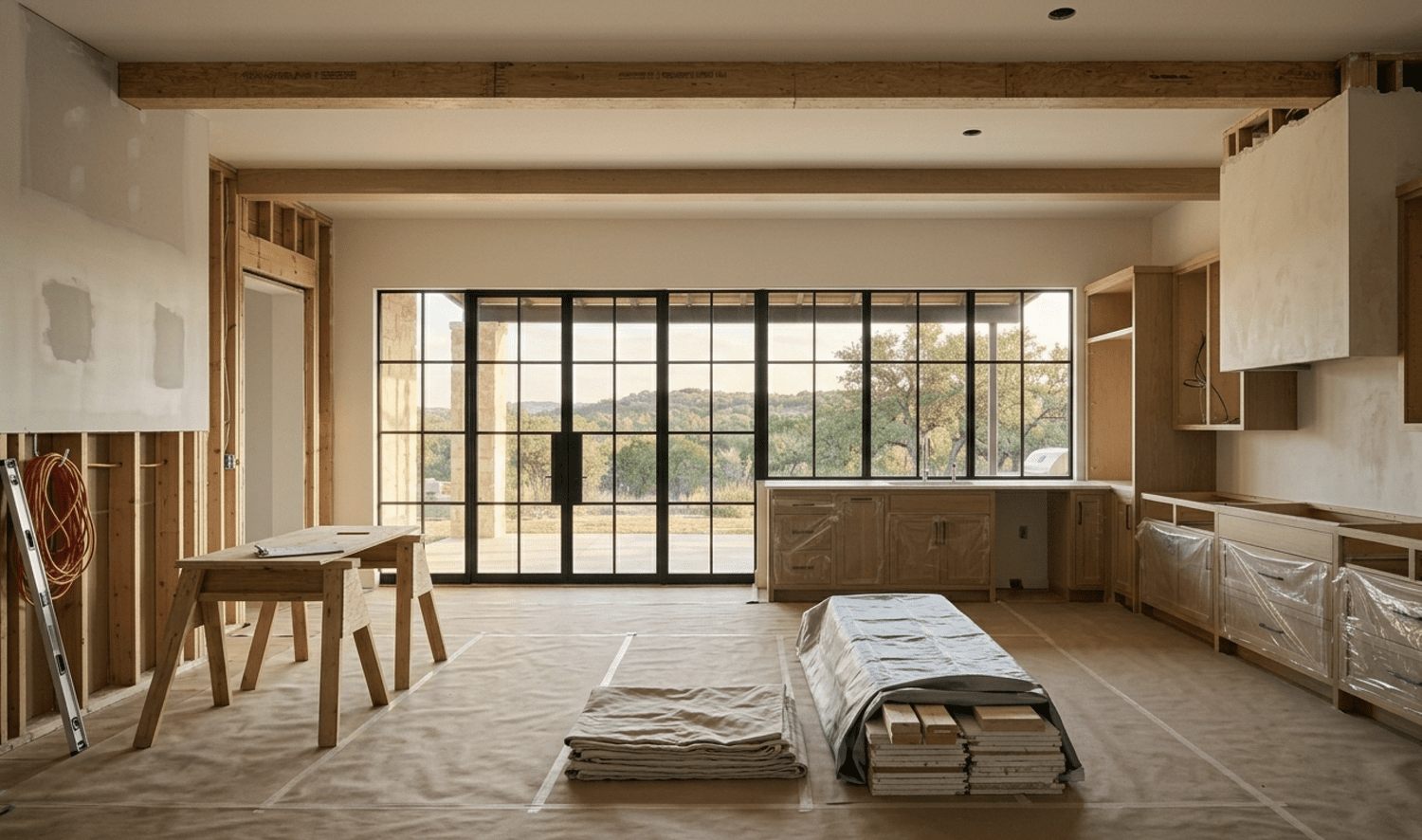
Three different answers to this question are sitting on the first page of Google right now, and they disagree by more than a year. They are not all wrong. They are measuring different things, and none of them is measuring the span a homeowner actually lives through.
The Short Answer
We would schedule a barndominium on the same basis as any custom home we build, typically 14 to 20 months from signed contract to handover. Shorter published timelines usually measure from the start of construction rather than from signing, or describe a shell rather than a finished home.
Why the Answers Disagree
The Published Timelines Are Measuring Different Spans
Read the barndominium timeline articles closely and the qualifier is usually right there in the sentence. One Central Texas builder puts a barndominium at six to twelve months from the start of physical construction to move-in. A steel building seller puts a metal building barndominium at three to six months, which is a shell timeline. Our own timeline of 14 to 20 months runs from the day a contract is signed.
So the gap between three months and twenty months is mostly not a disagreement about how fast anyone builds. It is a disagreement about when the clock starts and what counts as finished. Once you line the spans up, the numbers stop fighting each other.
What the Data Shows
What the US Census Data Says About Build Time in the South
The US Census Bureau tracks how long new houses actually take, and it publishes the answer by region and by who built the house. The pattern in the 2024 data is the single most useful thing in this article, because it separates production homes from one-off homes.
| Time from start to completion | Homes built for sale | Contractor-built |
|---|---|---|
| 3 months or less | 19% | 12% |
| 4 to 6 months | 59% | 28% |
| 7 to 9 months | 15% | 23% |
| 10 to 12 months | 4% | 13% |
| 13 months or more | 4% | 23% |
Percentages are rounded and may not total 100. These are regional survey estimates for the South as a whole, not a forecast for any one project, and the smallest cells carry wide sampling error.
The Census splits these by who the house was built for. A home built for sale was built to sell, which in practice usually means a subdivision lot with water, sewer, power and a paved road already in place. Nearly four in five finish within six months. A contractor-built home was built for the owner, on the owner’s land, under a general contractor, which is what a custom barndominium is. Almost a quarter of those take 13 months or more, and 12 percent finish in three months or less.
The fast timelines are real. They describe a different kind of project from the barndominium most people picture on their own acreage.
Where the Clock Starts
The Census Clock Starts at Construction, Not at Your First Meeting
Here is the limit on that data, and it matters more than the percentages. The table measures construction start to completion. Everything before the first day of construction sits outside it: design, engineering, structural drawings, bidding, the contract, the septic site evaluation and permit, scheduling a well, and getting electric service to the building site. The Census reports the interval from authorization to start separately, and in the South about seven in ten single-family homes start within a month of authorization.
So these figures are not wrong and they are not hiding rural work. The survey covers construction in areas where building permits are not required as well. They simply answer a narrower question than the one you are asking, which is how long it takes from the day you decide to go ahead.
That is why we quote from signed contract to handover. It is a longer number and a less attractive one, and it is the span you can plan around, though choosing land and doing feasibility work often happen before there is a contract at all.
What Moves a Schedule
What Actually Extends a Hill Country Build
On a Hill Country parcel the schedule risk usually sits with the land and the approvals rather than with the house itself.
- The septic design and permit. Texas requires a site evaluation by a licensed site evaluator or professional engineer before an on-site sewage facility is permitted, and the soil investigation drives which system types are even available to you. Thin soil over limestone narrows the options.
- Water. A well has to be scheduled with a licensed driller, and groundwater districts here require paperwork before drilling begins, not after. In Blanco County the district requires written authorization before a new well is drilled, and registration applies to wells countywide.
- Electric service. Getting power to a building site on acreage can mean a line extension, which is a utility project with its own queue.
- Rock. Limestone close to the surface affects the foundation, the driveway, the septic trenches and every utility run on the property.
- Access. A driveway, a culvert and a road approach can each need their own permission.
None of those items care what the house is framed with. They are the reason a barndominium on raw acreage and a conventional custom home on the same acreage end up on roughly the same schedule. We go through the same ground in what the rock does to a foundation here, because the rock is usually the first thing that surprises people.
Is the Shell Faster
Yes, the Shell Goes Up Faster, and It Is a Small Share of the Job
A post-frame or steel shell really can be erected quickly, and that is a genuine advantage of the form. The part people miss is what share of a finished house the shell represents. A faster shell does not remove the foundation, the well, the septic system, the plumbing, the electrical, the mechanical systems or any of the finishes. Those items are most of what a finished house costs and most of what it takes in time, and their design and the time they take still depend on the project.
A shorter framing stage also does not shorten a septic permit review, a well schedule or a utility line extension. Whether it shortens the whole schedule depends on fabrication, delivery, site work and approvals. We go through the money side of the same question on what a barndominium costs here, and the way we run a project from first conversation to handover is set out on our process page.
Common Questions About Barndominium Build Time
How long does it take to build a barndominium?
We use the same schedule for a barndominium as for any custom home, 14 to 20 months from signed contract to handover. Shorter published timelines usually measure only from the start of construction, or describe a shell rather than a finished home.
Why do some builders say three to six months?
Usually because they are describing a different deliverable or a different span. When you compare a short estimate with a longer one, check whether it covers a shell or a finished home, and whether it starts at contract signing or at construction. One Central Texas builder states its range of six to twelve months as measured from the start of physical construction.
Is a barndominium faster to build than a conventional house?
The framing stage can be shorter. Whether the finished house is faster depends on fabrication, delivery, site work and approvals, because the foundation, utilities, septic, mechanical systems and finishes still have to be built either way.
What do the Census figures show for the South?
For 2024, 59 percent of homes built for sale were completed four to six months after construction started, while 23 percent of contractor-built homes took 13 months or more. These are regional figures for the South, and they are not specific to Texas or to barndominiums.
What usually delays a rural build?
Approvals and site work tied to the land rather than the house. The septic site evaluation and permit, water supply, electric service extension, access and rock excavation all have to be addressed before or during construction.
Does a building permit apply in unincorporated Hays or Blanco County?
It depends on the county and what it has adopted. Counties in Texas have limited authority over single-family construction, and some have adopted inspection frameworks while others have not. Septic permitting, floodplain and access requirements apply separately regardless. Being outside city limits does not mean the work is exempt, so confirm what your parcel requires with the county before you plan around it.
When should I start if I want to move in by a particular date?
Work backwards from handover using 14 to 20 months, and start the land questions first. A site evaluation and a conversation about water, power and access can happen before any design work, and they are the items most likely to change the plan.
Do you give a schedule before I sign anything?
We walk the property, talk through what the land will require, and set out a realistic span before there is a contract to sign. If the honest answer for your parcel is longer than 20 months, we would rather say so early.
Sources for the figures above: US Census Bureau, housing units completed by months from start, 2024, US Census Bureau, housing units started by months from authorization, 2024, TCEQ, getting a permit for an on-site sewage facility, Blanco-Pedernales Groundwater Conservation District rules.
When You Are Ready
Talk Through Your Timeline Before You Commit to a Date
If you are working toward a move-in date, the land questions are the ones worth answering first. We are glad to walk your property and give you an honest span, including the parts of it that are outside anyone’s control.